Leave Your Message
So, when you're shopping around for Lab Equipment in China, you'll see plenty of options for Magnetic Stir Bar Removers. But here's the thing—choosing a reliable one isn't just about the price tag. You really need to think about how it fits your actual work. For example, check the usable length, the shape of the handle, how strong it pulls the stir bar out, and whether it works with the flasks and beakers you use every day. Honestly, having a remover that can reach all the way down into a narrow-neck flask can be a total game-changer—saves you so much time. And don't overlook the small stuff either. When you talk to suppliers, make sure you ask them to spell out exactly what materials they're using, especially for the magnet part and any coating on it. It makes a big difference in the long run. So you see a product called a 'PTFE Magnetic Stir Bar Remover' – sounds pretty official, right? But honestly, don't just take the name at face value. I mean, sure, the PTFE coating gives it a nice smooth, chemical-resistant surface – that's a given. But that alone doesn't mean it'll actually work for what you're doing. You've gotta dig into the specs and make sure it's built the way you expect. It's like buying a car because it says 'sporty' – you'd want to check under the hood first.
So when you're checking out a supplier in China, make sure to ask for dimensional drawings, product photos, samples, and any inspection records. Also, don't just assume they'll keep things consistent—you need to confirm they can maintain the same magnet placement, finish quality, and packaging from one order to the next. These are pretty basic checks, honestly. And before you sign off on anything, ask about customization options, MOQs, lead times, and how they handle export packing. You know, seasoned sourcing folks usually don't just take a supplier's word for it—they'll actually test samples in their own beakers and flasks. That little step can catch things like a clunky handle or a remover that's way too short. Honestly, a shiny listing doesn't mean much. You've gotta compare their written answers with real product evidence, and be super specific about what you need. And hey, even after sampling, some stuff might still be up in the air. Might as well admit that upfront. Honestly, if you're on the lookout for a Magnetic Stir Bar Remover, taking a good look at your suppliers is key. It'll help you snag one that fits your lab's daily operations and makes replenishment a no-brainer.

A magnetic stir bar remover is a handheld tool used to lift a stir bar from a liquid or vessel. Its magnet attracts the small bar through the container wall, so the user can retrieve it without pouring out the sample. Many removers have a long, narrow handle and a magnet at the tip. This shape helps reach into tall beakers and narrow-necked bottles. It also keeps fingers away from liquids and glass edges. A simple tool, but a useful one.
Tips: Move the remover slowly toward the bar. Lift it steadily, and check that the bar is attached before carrying it away. Rushing can make it slip back into the vessel.
For routine lab work, consider the remover’s length, grip, and compatibility with the stir bars in use. A handle that is too short may not reach the bottom of a deep vessel. A very strong magnet can make separation awkward, while a weak one may not hold securely. Clean and dry the tool between uses when sample carryover matters. Even with care, retrieval can be fiddly in a crowded workspace; test the fit with your usual vessel before relying on it.
Laboratory research depends on small tools that support repeatable sample preparation. Grand View Research estimated the global laboratory equipment market at USD 58.6 billion in 2023 and projected a 7.2% compound annual growth rate from 2024 to 2030. As laboratories expand work across chemical and materials research, reliable accessories for routine mixing can help researchers handle samples more efficiently. A PTFE Magnetic Stir Bar Retriever is designed to attract and remove stir bars from vessels, reducing direct contact with solutions during handling.
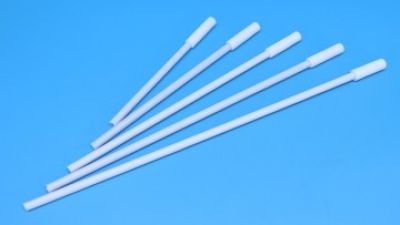
Available in lengths from 150 mm to 550 mm, the PTFE Retriever combines a stainless-steel core with an outer polytetrafluoroethylene sleeve. PTFE’s resistance to most acids, alkalis, and organic solvents makes the tool suitable for varied laboratory workflows. It can withstand working temperatures up to 250 °C, while retaining 5% elongation at -196 °C, supporting use across a wide temperature range. Its low-friction, non-adhesive surface also helps with handling and cleaning.
For chemical research, experimental laboratories, materials studies, and university settings, the retriever offers a practical complement to magnetic stirring equipment. Its corrosion resistance and aging durability are useful where tools encounter repeated exposure to solvents and changing conditions. China-based suppliers and factories can support consistent availability for laboratories purchasing in bulk.
It is a handheld tool that uses a magnet to lift a stir bar from a vessel. It can retrieve the bar without pouring out the liquid.
Its magnet attracts the stir bar through the vessel wall. Move the handle close to the bar, then lift gently. No direct contact is usually needed.
Thick glass, a deep vessel, or a large gap can weaken the magnetic pull. A quick lift may also make the bar slip. It can be fiddly.
Move it slowly toward the stir bar and check that the bar has attached. Lift steadily, keeping the tool over the vessel until you are sure it is secure.
Check the handle length, grip, magnet strength, and compatibility with your stir bars. Test it with your deepest vessel. Small details matter.
Measure the depth of your usual vessels and compare it with the remover’s working length. A short handle may not reach the bottom of a tall beaker.
Clean and dry it between uses when sample carryover matters. Check that the handle is sealed and can tolerate your routine cleaning method.
Request clear dimensions, material details, inspection information, packaging, and defect-handling terms. Ask for a sample and test it in your own vessels. A successful sample does not guarantee every later batch will match.
A Magnetic Stir Bar Remover is a simple laboratory tool used to retrieve a magnetic stir bar from a vessel without pouring out its contents. It works by bringing a magnetic end near the bar so the bar can be lifted or guided out. Removers come in different shapes and lengths, with common options made from coated magnets, stainless steel, or chemically resistant materials. The right choice depends on vessel depth, bar size, handling comfort, and compatibility with the liquids and cleaning methods used.
When comparing products, consider magnetic strength, durability, surface finish, ease of cleaning, and overall value. Buyers evaluating Chinese suppliers can review product specifications, manufacturing capabilities, quality-control practices, communication, and sample availability. Before ordering, confirm dimensions, materials, packaging, lead time, and pricing in writing; request a sample where practical, clarify inspection expectations, and check that the supplier can provide consistent documentation and after-sales support.