Leave Your Message
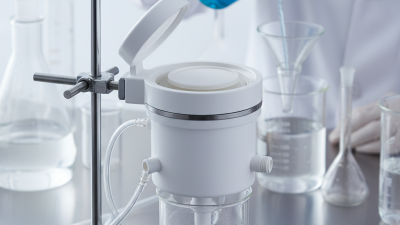
A Ptfe Filter Holder is a pretty handy little device designed to hold a PTFE membrane during filtration, venting, or sample prep. It’s usually made with a chemically resistant body, a sealing ring, and a threaded or clamp connection to keep everything in place. Imagine the membrane sitting inside like a stretched white drumhead—then pressure pushes liquids or gases right across its surface.
Dr. Laura Chen, a filtration engineer over at ClearStream Technologies, often reminds folks, “Good filtration depends just as much on the holder as on the membrane itself.” Her point? Even the perfect PTFE membrane can fail if you mess up the sealing, pressure, or chemical compatibility. The holder helps keep the membrane flat, prevents flow from bypassing, and directs the filtered stuff toward the outlet. Plus, since PTFE is hydrophobic, it’s great for separating particles from air, nasty gases, and many chemical vapors.
How it works isn’t complicated, but you do need to pay attention—not just go in all reckless. The contaminated fluid goes in through the inlet, and pressure pushes it through the membrane’s tiny pores. Particles stay on the upstream side, while the clean fluid comes out below. The performance depends on factors like pore size, pressure, temperature, and flow rate—so every little detail matters.
Before you get started, it’s smart to check if the chemicals are compatible with your membrane and to make sure the seal is intact. Over-tightening can warp the seal, and too little pressure might reduce efficiency. Also, if you’re working with water-based samples, wetting can be a bit tricky because PTFE tends to repel water. That’s where experience comes in—sometimes pre-wetting the membrane, trying a different treatment, or switching to another filter material helps. Understanding these little quirks makes using a PTFE Filter Holder safer, more reliable, and easier to pick for your lab or industrial setup.
What Is a PTFE Filter Holder?
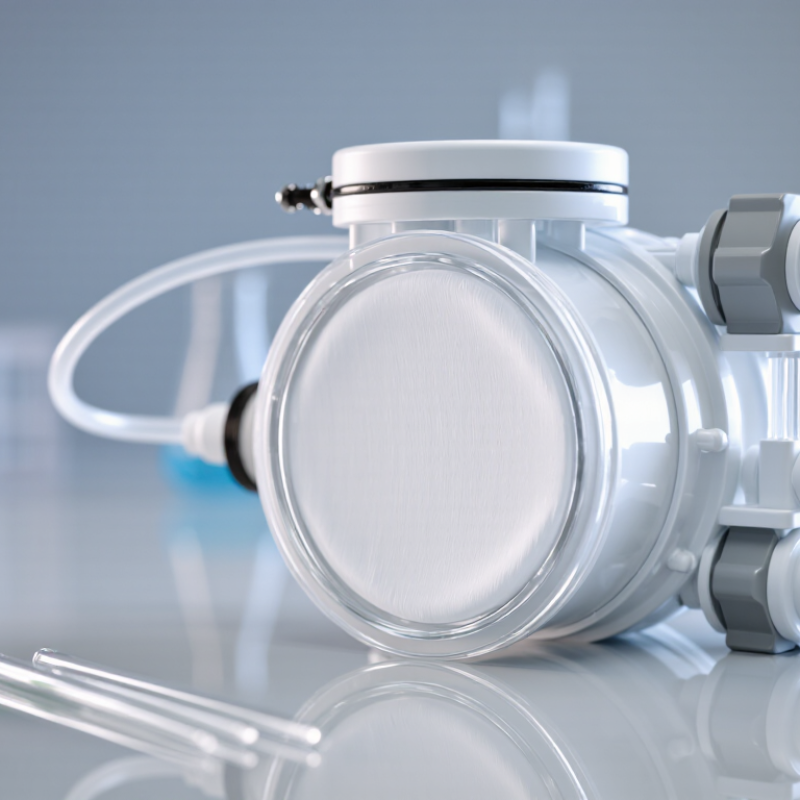
A PTFE filter holder is a small device that secures a PTFE membrane during liquid or gas filtration. PTFE, or polytetrafluoroethylene, resists many aggressive chemicals and tolerates demanding laboratory conditions. The holder usually includes an upper body, a support plate, seals, and an outlet connection. Together, these parts keep the membrane flat and reduce bypass around its edges.
The filter holder creates a controlled path through the membrane. A pump or pressure source moves the sample toward the filter surface. Particles remain on the membrane, while the filtered fluid passes through the support plate and exits the holder. A 25mm Filter Holder suits small-volume sampling and routine testing. Its compact size also helps reduce sample waste. However, membrane diameter alone does not confirm compatibility. Check the seal material, connection type, pressure rating, and chemical resistance before use.
In practical work, I inspect the sealing surface for scratches and residue. Even a small fiber can cause leakage. I also wet the membrane when required, because some PTFE membranes repel water. This step can be easy to overlook. For aqueous samples, a compatible pre-wetting liquid may improve flow, but it can also affect the sample. That detail deserves review. Hand-tightening is often safer than excessive force, which may deform the holder or damage the membrane. Regular inspection remains important, especially after repeated cleaning cycles.
| Data Dimension | Description | Practical Information |
|---|---|---|
| Definition | A PTFE filter holder is a housing or support assembly designed to secure a PTFE membrane or filter element during liquid or gas filtration. | It keeps the filter in position, provides a sealed flow path, and helps prevent bypass around the filter. |
| Main Function | To direct the sample or process stream through the filter medium while retaining particles, aerosols, or microorganisms according to the membrane specification. | The holder itself does not determine filtration performance; the membrane type, pore size, effective area, and operating conditions do. |
| Typical Construction | Common assemblies include a filter-support surface, inlet and outlet ports, a sealing element, a clamp or threaded closure, and a body made from a chemically suitable material. | The holder material should be selected for chemical compatibility, temperature, pressure, and the required level of cleanliness. |
| PTFE Membrane Characteristics | PTFE is a fluoropolymer known for broad chemical resistance, low surface energy, and hydrophobic behavior in its untreated form. | Hydrophobic PTFE is commonly selected for gases, vents, and non-aqueous liquids. Hydrophilic PTFE is available for aqueous liquid filtration. |
| Operating Principle | A pressure difference moves the feed stream toward the lower-pressure side, while the PTFE membrane retains particles larger than its rated pores or captures particles through the specified filtration mechanism. | Flow may be driven by a pump, compressed gas, vacuum, or a pressure vessel, depending on the holder design. |
| Flow Path | The feed enters through the inlet, spreads across the upstream side of the membrane, passes through the filter, and exits through the outlet. | A correctly installed gasket or O-ring is essential to stop unfiltered fluid from flowing around the membrane. |
| Common Filter Formats | PTFE filters may be supplied as flat discs, capsules, cartridges, or integrated vent filters. | The holder must match the filter format, diameter or connection size, sealing geometry, and intended flow direction. |
| Typical Applications | Applications include solvent filtration, corrosive chemical processing, gas and air venting, sample preparation, laboratory testing, and protection of sensitive equipment. | The specific membrane grade and holder design must be verified for the fluid, temperature, pressure, and cleanliness requirements. |
| Liquid Filtration Consideration | Untreated PTFE is naturally hydrophobic and may resist wetting by water-based liquids. | For aqueous samples, use a hydrophilic PTFE membrane or pre-wet the filter only when the membrane manufacturer's instructions permit it. |
| Pressure and Temperature | Allowable pressure and temperature are determined by the holder body, membrane support, seals, connections, and the complete assembled system. | Do not use the temperature capability of PTFE alone as the rating for the complete filter-holder assembly. |
| Advantages | PTFE filter systems can offer strong chemical resistance, low extractables when properly selected, and effective filtration of gases and compatible liquids. | They are useful where chemical exposure or solvent compatibility limits the use of other membrane materials. |
| Limitations | Performance can be affected by membrane wetting, differential pressure, particle loading, seal compatibility, and the chemical properties of the process stream. | A filter may clog or experience reduced flow as retained solids accumulate on the membrane surface. |
| Installation Steps | Inspect the holder, place the membrane in the correct orientation, seat the gasket, close the housing evenly, and connect the inlet and outlet lines. | Avoid folds, wrinkles, contamination, excessive tightening, and reversed flow unless the design specifically permits it. |
| Maintenance | Routine maintenance includes inspection, cleaning where applicable, seal replacement, leak checking, and replacement of damaged or loaded membranes. | Cleaning methods must be compatible with the holder, seals, support materials, and the required level of cleanliness. |
| Selection Checklist | Evaluate fluid compatibility, membrane wettability, pore rating, flow rate, effective filtration area, connection type, pressure, temperature, seal material, and cleaning requirements. | The correct choice is based on the complete filtration system rather than the PTFE membrane or holder considered separately. |
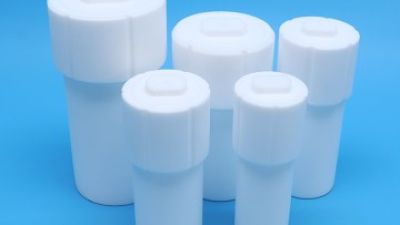
High-pressure PTFE Digestion Tanks are designed for reliable sample preparation in COD analysis and other laboratory digestion procedures. Manufactured from virgin, high-purity PTFE, these vessels provide strong resistance to acids, alkalis, solvents, and other reactive chemicals. Their smooth, burr-free inner surfaces make cleaning easier and help reduce contamination between experiments. The white vessels are available in 10 ml, 30 ml, 50 ml, 100 ml, and 200 ml capacities, with custom sizes available for specific laboratory requirements.
During COD testing, the tank supports controlled digestion and helps improve the reproducibility of chemical reactions. It is also suitable for general laboratory synthesis and chemical processing where dependable corrosion resistance is required. The material can tolerate temperatures from approximately -196°C to +250°C; however, for safer routine operation, the temperature should remain below 200°C and internal pressure should not exceed 0.4 MPa. When heating, the inner cap must not be completely sealed, allowing excess pressure to escape and reducing the risk of vessel damage.
When selecting a China supplier, laboratories should evaluate PTFE purity, dimensional consistency, cap design, surface quality, volume availability, and export packaging. A reliable manufacturer can provide secure transit protection, customization support, and stable production quality for repeated experimental use.
It secures a thin PTFE membrane during liquid or gas filtration. Its body, support plate, seals, and outlet guide the sample.
The sample enters through an inlet and spreads across the membrane. Pressure pushes fluid through microscopic pores. Particles remain upstream.
The gasket blocks flow around the membrane edge. Even a tiny leak can change the result. Small leaks matter.
Common designs include inline, vacuum, syringe, and disc holders. Inline models suit tubing systems. Syringe holders suit small samples.
Check membrane diameter, pressure, temperature, sample volume, connections, and chemical compatibility. Diameter alone is not enough.
PTFE naturally repels water. Pre-wetting with a compatible liquid may improve flow. However, it can affect sensitive samples.
Particle buildup may restrict flow. Air pockets, poor distribution, or uneven sealing can create similar readings. The cause is not always obvious.
Inspect the sealing surface, gasket, and support screen under bright light. Remove fibers and residue. Tighten gently.
Repeated cleaning may damage seals or leave residue. Inspect the holder after cleaning. I would not assume it remains unchanged.
Record the membrane size, holder style, tubing length, connector type, and flow direction. These small details can change performance.
A Ptfe Filter Holder is a specialized device designed to secure a PTFE membrane or cartridge while allowing liquids or gases to pass through for controlled filtration. Its structure typically includes a chemically resistant PTFE body, support surfaces, sealing elements, inlet and outlet connections, and a fastening system that keeps the filter stable during operation. Depending on the application, holders may be configured as inline units, vacuum assemblies, pressure housings, or compact laboratory models.
Inside the holder, the fluid enters through the inlet and spreads across the filter surface. Particles and unwanted substances are retained by the membrane, while the filtered fluid exits through the outlet. PTFE is valued for its broad chemical resistance, low surface energy, and suitability for demanding environments. However, its strength, temperature range, sealing requirements, and compatibility with the process should be considered carefully. Typical applications include laboratory testing, chemical processing, air and gas sampling, solvent filtration, and other environments requiring clean, reliable separation.